Special Examination Arrangements for VCE external assessments
Updated December 2025
Eligibility
Special Examination Arrangements may be approved for students with disabilities, illnesses or other circumstances that affect their ability to access a VCE external assessment. VCE external assessments include all VCE performance, Languages oral and written examinations, the Extended Investigation Critical Thinking Test and Externally-assessed Task oral presentation, and the General Achievement Test (GAT).
Special Examination Arrangements applications are made to the VCAA through the student’s school and must be endorsed by the principal and will be considered by the VCAA in accordance with the VCAA Special Provision policy.
The VCAA recognises that some students with a disability, as defined in the Disability Discrimination Act 1992 (Cwlth), illness, injury or personal circumstance may require Special Examination Arrangements to enable them to access examination/test questions and communicate their responses in a timed VCE external assessment.
The VCAA considers a large number of applications for Special Examination Arrangements every year. As it is the school that makes the application on behalf of students, and will ultimately administer their VCE external assessments, the VCAA’s consultation with a student and/or their representative will usually take place through their school.
Schools must not permit a student to receive Special Examination Arrangements without the VCAA’s approval. Failure to comply with these instructions may constitute a breach of the rules governing the conduct of VCE external assessments.
The VCAA considers each application for Special Examination Arrangements on a case-by-case basis. The VCAA will make a decision based primarily on the school-based evidence taking into consideration any additional academic and educational assessments and independent evidence provided with the application.
Submitting an application for Special Examination Arrangements - How to apply
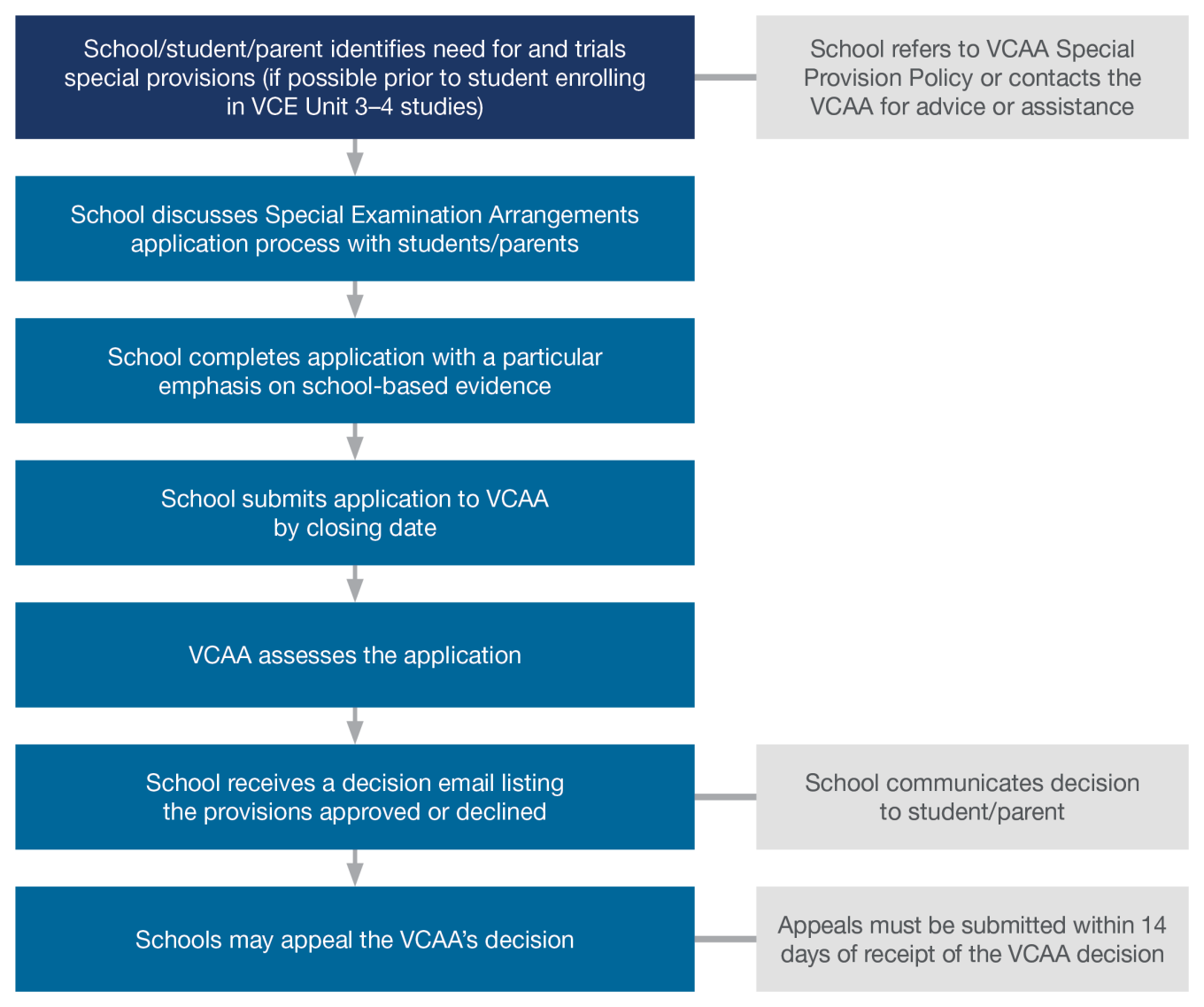
What schools need to do
Schools are responsible for identifying which students may be eligible for special provision for classroom learning, School-based Assessments and VCE external assessments. Many students will already be known to school staff, having been identified through established and ongoing support programs and discussions with teachers and/or parents/guardians.
In relation to VCE external assessments, schools need to determine the functional impact of a student’s condition(s) on their ability to access and respond to timed assessments. They should consider the individual student’s circumstances, any existing special provision for classroom learning and/or School-based Assessments, teacher observations and any existing professional evidence when confirming and/or determining which Special Examination Arrangements to apply for.
Schools should consult the VCAA if they are unsure about appropriate arrangements.
Schools apply for Special Examination Arrangements using the VCAA’s Special Provision Online (SPO) system.
Applications can be submitted in the year the student first enrols in a VCE or scored VCE VET Unit 3–4 sequence. Students who are approved Special Examination Arrangements for ongoing conditions can generally expect that these arrangements will be replicated for any additional VCE or scored VCE VET Unit 3- 4 sequences undertaken in subsequent years.
New evidence may also be submitted to support an existing application if there is a new diagnosis or deterioration in an existing condition.
What the VCAA will do
The VCAA will aim to approve Special Examination Arrangements for VCE external assessments consistent with any existing special provisions implemented by the school for classroom learning and/or School-based Assessments.
If necessary, the VCAA will contact schools to seek clarification or request additional information to support the assessment of an application.
The VCAA’s decision regarding a student’s Special Examination Arrangements will be communicated to the school via email. The school is responsible for communicating the decision to the student.
Appealing a decision
Schools may appeal a VCAA decision. Appeals should be submitted by the school within 14 days of receiving a decision email. The appeal should state why the VCAA decision is being challenged and include any new supporting information, such as school-based evidence and teacher observations and, if appropriate and available, additional letters of support from professionals and/or educational and academic tests not previously submitted.
The VCAA will process all appeals within 21 days of receipt of an appeal. The outcome will be communicated to schools via email. The school is responsible for communicating an appeal decision to the student.
Administering approved Special Examination Arrangements
Schools must ensure a copy of any approved Special Examination Arrangements are distributed to the student, relevant school personnel and the examination chief supervisor.
The VCE Coordinator or delegate must ensure there is a common understanding between the school personnel, student and supervisor as to precisely what any approved Special Examination Arrangements entail.
Schools must contact the VCAA Special Provision team if they are unsure about how to administer any of the Special Examination Arrangements approved for a student.
Emergency Special Examination Arrangements
Schools may submit an Application for Emergency Special Examination Arrangements if a student experiences a sudden illness, injury or personal circumstance immediately before or during an external assessment period.
The application will be available on VASS two weeks before the commencement of each assessment period for VCE external assessments.
If a student is ill on the day of, or during an external assessment, the school should contact VCAA Special Provision on 1800 205 455 to request approval of Emergency Special Examination Arrangements. Follow-up medical documentation may be required.
Where medical evidence is required to support an emergency application, it should contain:
- an outline of symptoms and treatment, date of onset and consultation
- comments on the likely effect of the illness or condition on the student’s capacity to complete VCE external assessments
- any medical recommendations for particular Special Examination Arrangements
Types of Special Examination Arrangements
Special Examination Arrangements can include the following:
Rest breaks
Rest breaks are typically approved at a rate of 10 minutes per hour of the 'total examination writing time'. In specific circumstances, the VCAA may approve ‘untimed rest breaks’ to facilitate management of a significant medical or physical condition.
Students may decide how to manage their allocation of rest breaks, including when and how long each break will be, with the supervisor noting the start and end times on the Special Examination Arrangements Rest Break Log Sheet.
The rest break allocation displayed on the VASS Special Examination Arrangements Advice Slip must not be exceeded. Students must be offered the full allocation of reading and writing time, in addition to the time taken for rest breaks.
Students may take rest breaks at any point during the external assessment, including during reading time.
Students:
- are not permitted to leave their table or leave the examination room during rest breaks, except where approved by the VCAA or if required to due to an emergency or other circumstances.
- are not permitted to read or write or access the examination/test questions or their responses during a rest break. Papers must be turned face down during a rest break.
- may use their rest break to relax, rehearse previously learned coping strategies, focus their thoughts or reflect on their responses.
Extra working time
Extra working time is typically approved at a rate of 10 minutes per hour of the 'total examination writing time'. ln specific circumstances, the VCAA may approve 'extra working time' in excess of 10 minutes per hour. Refer to the individual student Special Examination Arrangements advice slip for approved extra working time.
Separate rooms for individual students
Schools may consider the use of a separate room appropriate in a timed assessment setting to manage an individual students’ specific condition(s)/circumstance(s) including:
- anxiety disorders, attention deficits, physical disability or mental health issues which may impair a student’s ability to concentrate or perform under standard conditions in the main examination room.
- disruptive behaviour disorders where the condition impacts on a student’s ability to concentrate or control impulses that are likely to disrupt other students in the main examination room.
Acknowledging the logistical challenges for some schools associated with finding separate rooms and additional staff eligible to supervise individual students, schools are encouraged to consider whether a small group setting would be appropriate where there are a small number of students with the same or similar Special Examination Arrangements and conditions/circumstances in an examination session.
A request for the use of a separate room for an individual student needs to clearly outline why the student cannot be accommodated in the main examination room or a small group setting.
If approval has been granted for the use of a reader (or electronic reader), scribe (or electronic scribe), a clarifier, an Auslan interpreter and/or assistive technology, a student must complete their external assessment in a separate room and a separate supervisor must be present.
Small group settings
Where there are two or more students with the same or similar conditions/circumstances and Special Examination Arrangements in an examination session and they would benefit from a smaller, less distracting environment but do not necessarily need to be located in a separate room on their own, schools should consider applying for a small group setting.
Small group settings are a viable option to consider for students experiencing anxiety disorders, attention deficits, physical disability or mental health issues.
While schools can determine the size of each small group setting, the VCAA recommends a range between 2 to 16 students per examination session.
Schools may appoint one supervisor for every eight students completing a VCE external assessment in a small group setting.
Group Computer Rooms
If a school has one or more students with the use of a computer approved in a single examination session, the school may seat these students together in a group computer room, unless the use of a separate room has been approved due to a student's individual circumstances.
Schools may appoint one supervisor for every eight students to monitor these students as well as carry out general supervision.
Use of computers, tablets and/or assistive technology
The following table outlines the responsibilities of, and actions required by schools, supervisors and students when the use of a computer and/or assistive technology (text-to-voice or voice-to-text software) has been approved.
| The school must: |
|
|---|---|
| A school with students seated in a group computer room must also ensure: |
|
| The supervisor must: |
|
| Students: |
|
Readers
The function of a reader is to read the examination/test paper and/or the student's responses as often as requested by the student. A person appointed as a reader should
- be fluent in English
- be familiar with the VCE study being examined
- be patient and sensitive to the student’s requirements
- understand the need to maintain confidentiality,
The appointed reader may work with the student in any practice examinations, but not in any formal school-based assessments.
A supervisor, in addition to the reader, must be present in the examination room and monitor all interactions between the reader and the student.
| Readers can: | Readers cannot: |
|---|---|
|
|
Electronic readers (text-to-voice devices)
If a student is approved the use of an electronic reader or reader software, they must be supervised in a separate room.
| Supervisors must: | Students must: |
|---|---|
|
|
If the use of a reader or electronic reader is approved, extra working time at a rate of ten minutes per hour of writing time will be approved.
Scribes
The function of a scribe is to record, on the appropriate response material, the verbal responses and directions made by the student in the process of answering the question/s.
A person appointed as a scribe should:
- be fluent in English
- be familiar with the VCE study being examined
- be patient and sensitive to the student’s requirements
- understand the need to maintain confidentiality.
The appointed scribe may work with the student in any practice examinations, but not in any formal school-based assessments.
On behalf of the student the scribe will:
- complete all written details associated with the external assessment on the response materials, such as the VCAA student number, study title, the numbers of all questions and/or tasks answered and the number of answer books used
- record the student’s responses, as dictated by the student
- re-read the student responses for editing purposes, if requested by the student.
These tasks are to be completed within the total approved writing time.
If the use of a scribe is approved, a separate room will also be approved and extra working time at a rate of ten minutes per hour of writing time will be approved.
A supervisor, in addition to the scribe, must be present in the examination room and monitor all interactions between the scribe and the student.
Before the commencement of the external assessment, the student should advise the scribe how they propose to answer the examination or test questions.
Fifteen minutes before the end of the examination, the supervisor must announce to both the student and the scribe the time remaining. At the conclusion of the external assessment, the supervisor must inform both the student and the scribe that writing should cease.
| Scribes can: | Scribes cannot: |
|---|---|
|
|
| Students can: | Students cannot: |
|---|---|
|
|
Electronic scribes (voice-to-text devices)
If a student is approved the use of scribing software, they must be supervised in a separate room.
| Supervisors must: | Students must: |
|---|---|
|
|
If the use of a scribe or electronic scribe is approved, extra working time at a rate of ten minutes per hour of writing time will be approved.
Clarifiers
The function of a clarifier is to clarify words contained within examination/test questions. The appointed clarifier may work with the student during any practice examinations.
The clarifier may use a dictionary or thesaurus during the examination.
Clarification can occur during reading and writing time.
| For students with a language disorder, clarification is restricted to | For students who are deaf or hard of hearing, clarification is restricted to |
|---|---|
|
|
The student and the clarifier are permitted to write the clarification on the examination question/task book.
Discussion about answers, or prompting, must not occur.
Clarifiers may only clarify English sections of a language written examination.
Strict conditions apply for the use of a clarifier in any VCE external assessment. If approved, the school must ensure that a copy of the clarifier instruction document (available on VASS) as indicated on the school copy of the Special Examination Arrangements Advice Slip, is given to the supervisor and the clarifier. lt is the supervisor's responsibility to ensure that the instructions are followed.
The supervisor, in addition to the clarifier, must be present in the examination room and monitor all interactions between the clarifier and the student.
If the use of a clarifier is approved, extra working time at a rate of ten minutes per hour of writing time will be approved.
Auslan interpreters
A person appointed as an Auslan interpreter should:
- be fluent in both English and Auslan
- be familiar with the subject matter being examined
- be patient and sensitive to the student’s requirements
- be impartial, objective and understand the need to maintain confidentiality.
The role of the Auslan interpreter is to facilitate communication between the student and the supervisor, or between the supervisor, the student, and the reader, scribe and/or clarifier. The Auslan interpreter must sign everything that is spoken and voice everything that is signed so that the student is able to participate fully and equally in the external assessment.
Auslan interpreters cannot add or omit information or modify the original message. Auslan interpreters cannot assist the student with their work, including advising or prompting for answers.
Alternative format examination
Alternative format examinations refer to examinations modified from the standard format to accommodate the specific needs of a student and can include enlarged print, electronic text and Braille.
Sitting VCE external assessments at an alternative location
ln exceptional circumstances the VCAA will approve a student to sit an external assessment at an alternative location for example, at home or in hospital. Such circumstances would include cases of serious illness and physical or psychological incapacity.
Schools should consult the VCAA before requesting this Special Examination Arrangement.
Use of Electronic Headphones (including electronic ear buds)
| The school must: |
|
|---|---|
| The supervisor must: |
|
| Students: |
|
Provisions schools may approve for VCE external assessments that do not require VCAA approval
- Furniture, e.g., standing desk
- Cushion
- Foam/Silicon Ear Plugs (recommended not to be worn during initial announcements)
- Specific lighting requirements
- Coloured lenses for glasses
- Coloured overlay
- tissues
School personnel are responsible for ensuring the chief supervisor/supervisors are made aware of any of the above items being approved for individual students and to check these items prior to students entering the examination room.
Special Provision categories and appropriate provisions
Students are eligible for Special Examination Arrangements if their capacity to access a VCE external assessment is impaired due to one or more of the following:
Mental health conditions
A mental health condition is a disorder or illness that affects a student’s thought processes, judgement, perception of reality, or emotional and social wellbeing. The symptoms significantly impact on a student’s cognitive functioning. The current presenting symptoms must be supported by evidence from a range of sources including a student’s history, school observations or appropriate health professionals that outline the level of functional impact.
Appropriate provisions
The overwhelming consensus among professionals that work with students with Mental Health conditions is that in most circumstances rest breaks are considered the most appropriate provision to manage symptoms that significantly impact on cognitive functioning.
Mental health conditions impact directly on mood, thinking and behaviour and, in an examination environment, may impact on a student’s ability to concentrate.
Rest breaks provide students with an opportunity to use taught techniques to manage their thoughts, emotions and feelings.
| Condition | Possible difficulties under test conditions | Possible arrangements |
|---|---|---|
| Anxiety disorders | Concentration difficulties, anxiety preventing performance in group situations | Rest breaks, permission to leave examination room, small group setting, separate room for individual student |
| Attention-deficit and disruptive behaviour disorders | Concentration and difficulty with impulse control | Rest breaks, permission to take medication, permission to leave examination room, small group setting, separate room for individual student |
| Eating disorder (Anorexia nervosa, Bulimia nervosa) | Fatigue, concentration difficulties, need to accommodate eating plans | Rest breaks, permission to bring food or drink into examination room, permission to leave examination room, small group setting, separate room for individual student |
| Depression | Concentration difficulties, difficulties remembering and making decisions, fatigue and tiredness | Rest breaks |
| Bipolar disorder | Fatigue, restlessness, irritability, disorganised behaviour, difficulty with memory and concentration | Rest breaks, permission to leave examination room, small group setting, separate room for individual student |
| Schizophrenia | Memory loss, mental confusion, slowness in activity, fatigue | Rest breaks, small group setting, separate room for individual student |
| Obsessive Compulsive Disorder | Recurrent unwanted thoughts and/or repetitive behaviours | Rest breaks, permission to leave examination room, small group setting, separate room for individual student |
Requests for extra working time
Requests for extra working time, solely on the basis of a mental health condition, should be accompanied by evidence that demonstrates significant impact on a student’s executive and cognitive functioning and a decline in academic performance. The evidence may include:
- school-based evidence that demonstrates a decline in the student’s performance as a result of the condition. This may include the student’s work before and after the onset of the mental health condition
- school observations and history of other provisions (namely rest breaks) being trialled unsuccessfully
- the results of any psychological testing previously administered
- a health professional statement outlining the symptoms and why extra writing time is required.
Schools are encouraged to contact the VCAA Special Provision team to discuss specific student cases before applying for extra working time.
Health impairment or physical disability
Appropriate provisions
| Condition | Possible difficulties under test conditions | Possible arrangements |
|---|---|---|
| Autism spectrum disorder (ASD), Attention-deficit/hyperactivity disorder (ADHD) | Cognitive functioning, communication or concentration difficulties, social interaction, behaviour | Rest breaks, small group setting, separate room for individual student, permission to leave examination room. If difficulties relate to learning, reading, writing, mathematics, problem solving or the acquisition of and use of language, extra working time, use of a computer or assistive technology may be appropriate. |
| Back injury/chronic pain | Pain and/or discomfort due to injury, problems with prolonged sitting | Rest breaks, permission to take medication, permission to stand and stretch (schools can provide a standing desk), permission to leave examination room |
| Crohn’s disease | Pain and/or discomfort | Rest breaks, permission to leave room |
| Chronic fatigue syndrome (for example, post-viral fatigue syndrome), myalgic encephalomyelitis | Tiredness/inability to concentrate due to illness | Rest breaks, permission to take medication, permission to bring food and drink into examination room. |
| Diabetes | Need to check blood sugar levels | Permission to take food and/or drink into the examination, permission to take medication, permission to leave examination room, rest breaks |
| Epilepsy | May suffer from epileptic seizure during examinations | Permission to take medication, separate room for individual student |
| Hand/wrist/arm/shoulder injury | Difficulty writing due to pain or discomfort in the hand and/or arm, excessive fatigue in the hand | Rest breaks, extra working time, a computer or a scribe/electronic scribe (voice-to-text) |
| Acquired brain injuries | Mental processing difficulty or slowness | Rest breaks, permission to take medication, extra working time |
| Muscular dystrophy, cerebral palsy, etc | Muscle weakness, restrictive use of limbs, communication difficulties | Permission to stand and/or stretch, permission to take medication, separate room for individual student, extra working time, computer, assistive technology, use of a scribe/aide, alternative format examination paper |
Specific learning disorders
Definition
Specific Learning Disorder is a neurodevelopmental disorder with a biological origin. Students with this disorder possess specific cognitive processing deficits that cause difficulties with learning and using academic skills and manifest in persistent problems with one or more of the following:
- inaccurate or slow and effortful word reading
- understanding the meaning of what is read
- spelling
- written expression
- mastering number sense, number facts or calculations
- mathematical reasoning.
Appropriate provisions
| Impairment in Reading (includes Dyslexia) | Impairment in Written Expression | Impairment in Mathematics (includes Dyscalculia) |
|---|---|---|
|
|
|
Language disorder
Definition
Language Disorder is a neurodevelopmental disorder impacting on a student’s acquisition and use of language across a range of modalities (that is spoken, written, sign language). Difficulties are evident in one or more of the following:
- Reduced vocabulary – the student struggles with understanding and expression of words.
- Limited sentence structure – the student struggles to formulate sentences that are both structurally sound and convey meaning.
- Impairments in discourse – the student struggles with providing adequate information, sequencing it appropriately and conveying intended meaning in connected speech.
Appropriate provisions
| Language Disorder (possible provisions based on functional impact on the student) |
|---|
|
Motor disorders
Definition
Students with a Developmental Coordination Disorder possess specific motor skill deficits which can cause significant difficulties with slowness and/or inaccuracy of handwriting.
Other disorders considered under this category include Stereotypic movement disorders and Tic disorders including Tourette disorder.
Appropriate provisions
| Developmental Coordination Disorder | Stereotypic movement disorder | Tic disorders |
|---|---|---|
|
|
|
Deaf and hard of hearing
Appropriate provisions
| Deaf and hard of hearing (possible provisions based on functional impact on the student) |
|---|
|
Students who are deaf or hard of hearing may be eligible for a clarifier to assist with their VCE external assessments if the student regularly uses a clarifier.
It is the school’s responsibility to plan appropriate seating arrangements in a VCE external assessment so a student who is deaf or hard of hearing can clearly see the chief supervisor and follow any communications and messages during the assessment.
If a specific technological device, such as Microlink assistive technology, is required or Auslan interpreting, this should be requested in the application.
Vision impairment
Appropriate provisions
| Vision impairment (possible provisions based on functional impact on the student) |
|---|
|
Evidence requirements for applications for Special Examination Arrangements
The VCAA requires the following evidence to support an application for Special Examination Arrangements:
- signed ‘Student consent’* form
- detailed ‘School-based evidence’*, which outlines:
- the student’s condition(s) (disability, illness, long-term injury or ongoing personal circumstance), including medical and educational history outlining the functional impact on learning and assessments
- history of provisions approved and used by the student over the period of the condition(s)
- evidence used to make decisions e.g., teacher observations and/or health professional
Any existing relevant academic and educational assessments and evidence used by the school to determine appropriate provision(s) may be provided to support an application.
*Available as downloads from the Victorian Assessment Software System (VASS)
The VCAA may seek further information from the school to support the assessment of an application, if necessary.
Examples of additional evidence that could be provided to support an application for Special Examination Arrangements
Evidence from an appropriate health professional. Ideally, the SPO Health Professional Statement should contain the following details:
Mental health conditions, Health impairment or physical disability
- clinical assessments, diagnosis (if available) and date of diagnosis
- consultation history, presenting symptoms, description of severity and expected duration
- treatment period and plan (if applicable and available)
- comments on how the illness or condition would impact on the student’s day-to-day functioning in the classroom
- comments on the likely effect of the illness or condition on the student’s capacity to complete VCE external assessments.
Specific learning disorder, Language disorder or Motor disorder
- Statement from a teacher(s) outlining why they believe the student is limited by time and not knowledge and what evidence they used to reach this conclusion (if not already provided in ‘School-based evidence’).
- Relevant diagnostic assessments completed by a registered Health or Allied Health Professional, e.g., Psychologist, Speech Pathologist, Occupational Therapist, Paediatrician or assessments completed by other qualified educational professionals.
Vision impairment
- Supporting evidence from an ophthalmologist, optometrist or from the Educational Vision Assessment Clinic (EVAC)
- Supporting information and recommendations from a specialist teacher from the Visiting Teacher Service, if available
Deaf and hard of hearing
Evidence from a qualified practitioner indicating the type of hearing loss including:
- an unaided audiogram and report
- supporting information and recommendations from a specialist teacher from the Visiting Teacher Service or school for hearing-impaired students, if available