Updated Foundation Levels A to D to support inclusive teaching

Victorian teachers will be supported in their delivery of inclusive teaching, with the publication of Foundation Levels A to D (FLA–FLD) for the Victorian Curriculum F–10 Version 2.0. This release strengthens the learning pathways for students with intellectual or cognitive disability or learning delay and reinforces every student’s right to a knowledge-rich, skills-focused education. Victoria has provided dedicated curriculum levels for these learners since 2011, and this well-established and comprehensive approach sets the benchmark nationally.
Foundation Levels A to D will replace Levels A to D (Towards Foundation) of the Victorian Curriculum F–10 Version 1.0. The Victorian Curriculum F–10 Version 2.0 includes Foundation Levels A to D for a reduced number of curriculums: 4 learning areas (English, Mathematics, the Arts, and Health and Physical Education) and 2 capabilities (Critical and Creative Thinking, and Personal and Social Capability). These 6 curriculum areas are fundamental to accessing learning across the curriculum, for supporting the balanced development of academic and functional skills, and for supporting the inclusion of age- and disability-appropriate content. The curriculum content was reviewed and updated using contemporary research and evidence, with input from teachers, allied health practitioners and subject matter experts. This work has helped to ensure that key knowledge and skills are clearly sequenced and scaffolded, supporting student learning into and beyond Foundation.
Importantly, the achievement standards and content descriptions have been designed to be used with all learners, regardless of age or disability. They centre students as active participants in their own learning, including those who may access Foundation Levels A to D throughout their schooling, and enable teachers to plan, teach, assess and monitor student learning.
Victorian schools began implementing Foundation Levels A to D for Mathematics in 2026, with some schools also choosing to implement Foundation Levels A to D for English. Full implementation of Foundation Levels A to D for English; the Arts; Health and Physical Education; Critical and Creative Thinking; and Personal and Social Capability will be required in Victorian government schools from 2027. Catholic schools should confirm implementation timelines with their diocese. Levels A to D (Towards Foundation) Version 1.0 will be discontinued from 1 January 2027, so schools should factor this into their planning for the 2027 school year.
We asked 4 teachers to share their reflections on how FLA–FLD supports student learning and classroom practice, and what motivates them as educators in this important space.
‘My hope is that every student leaves [our school] knowing they belong’ – Shivani Chand
When you think about your students’ futures, what are your hopes for them, and how do Foundation Levels A to D help to lay the foundation for that?
My hope is that every student leaves our setting knowing they belong, that their contributions matter, and that they have the skills and confidence to participate in their communities in whatever way is meaningful to them.
Foundation Levels A to D help lay the foundation for this by focusing on what truly matters for life beyond school: communication and self-advocacy, regulation and wellbeing, connection and relationships, agency and independence in daily life.
We're not preparing students for some distant future, we're helping them live full, dignified lives now, building capabilities that will serve them across every setting they enter. That’s the impact that keeps me passionate about this work.
What is a small reflection you have as a teacher working with students with diverse learning needs?
As a mentor and PLC [professional learning community] leader, I’ve seen firsthand how a culture of celebrating learning transforms not just students but entire teaching teams. It’s never about fixing anyone. It’s about creating environments where every achievement, no matter how small it might appear to others, is honoured as the significant milestone it truly is.
How do you use Foundation Levels A to D in your day-to-day teaching, and what makes them effective for supporting the diverse needs of your students?
What makes Foundation Levels A to D effective is the flexibility built into the framework. It acknowledges that progress isn't linear and gives me professional space to make judgements about what success looks like for each individual learner.
The FLA–FLD framework gives me a shared language and structure that I can bring my own expertise to. In practice, this means:
- starting with the student (not the curriculum) and understanding their strengths, communication preferences and sensory needs first
- using FLA–FLD as a roadmap rather than a checklist, allowing me to meet students exactly where they are developmentally
- embedding learning into meaningful, real-world contexts
- collaborating with families and therapists to ensure consistency across settings.
‘Every student deserves to feel included, supported and successful at school’ – Danny Thomas
What inspired you to become a specialist teacher working with students with diverse learning needs, and what continues to motivate you in this space?
I have a strong belief that every student deserves to feel included, supported and successful at school. Early in my teaching journey, I was drawn to the opportunity to work closely with individual learners, understand their unique strengths and challenges, and to find ways to make learning accessible and meaningful for them.
What continues to motivate me is seeing the growth that occurs when students are given the right support and opportunities. I enjoy getting to know each learner and helping them access learning in a way that works best for them. One of the most rewarding aspects of my role is watching students build confidence, develop greater independence and celebrate their achievements, no matter how big or small. Our students bring so many strengths, unique perspectives and determination to the classroom, and it is a privilege to support them on their learning journey and see them reach their goals.
In what ways do Foundation Levels A to D support you as a teacher to plan for learning and apply your professional expertise to meet each student where they are?
I use Foundation Levels A to D as the basis for planning, teaching and assessing learning in my classroom. In Mathematics, I use the curriculum content and elaborations to identify the specific skills and understandings I want each student to develop, and then design authentic learning experiences that make these concepts accessible and meaningful for my learners.
FLA–FLD allow me to tailor learning to students’ diverse needs and strengths while still providing clear learning goals and progression pathways. I can connect mathematical concepts to students’ interests, classroom topics and real-life experiences, which increases engagement and helps students make meaningful connections with their learning. This approach supports students to access the curriculum at their point of need, experience success and demonstrate progress.
Can you share a moment where you saw a student thrive using Foundation Levels A to D? What did success look like in that instance?
One memorable example involved a student working at Foundation Level C, who was learning to identify people within their everyday environment. At the beginning of the lesson, the student was reluctant to participate and showed little interest in the visuals or discussion activities. To increase engagement, I introduced a fun matching game supported by a graphic organiser, visual aids and photographs of family members, classmates and familiar community members.
As the activity progressed, the student gradually became more engaged and confident. Their participation increased and they began using their verbal communication skills to recognise and name the people in the visuals.
Success in this instance extended beyond the student’s achievement of independently recognising and identifying familiar people in their everyday environment. It was also evident in their growing confidence, positive body language and enthusiasm for learning. Seeing the smile on their face and their willingness to continue engaging with the lesson, even after the activity had finished, highlighted the meaningful impact of FLA-FLD in supporting both learning and personal growth.
‘Seeing that “lightbulb” or breakthrough moment motivates me every day’ – Amy Fitzgerald
What inspired you to become a specialist teacher working with students with diverse learning needs, and what continues to motivate you in this space?
When I was growing up, my mum worked with kindergarten students with diverse learning needs and our family provided in-home respite for a young person with a disability. I knew early on that this work was my passion and something I wanted to pursue as a career. I am motivated every day by my students – watching them develop an understanding of new concepts and seeing that ‘lightbulb’ or breakthrough moment motivates me every day.
How do you use Foundation Levels A to D in your day-to-day teaching, and what makes it effective for supporting the diverse needs of your students?
Having worked in a variety of education settings, [I think] Foundation Levels A to D provides an understanding of the continuum of learning for all students and helps me to ensure I am meeting the students at their point of need. I feel confident I am targeting the learning where it’s most impactful for students. Prior to Foundation Levels A to D, teachers simply didn’t have a consistent, meaningful framework in which to recognise, monitor and celebrate the progress of students with diverse learning needs, and these levels provide this.
Can you share a moment where you saw a student thrive using Foundation Levels A to D? What did success look like in that instance?
My experience has shown me that for some students, progress can be slower, and students may be working towards Foundation Levels A to D for many years. However, despite these students potentially remaining at the same level for some time, this does not mean that they do not have opportunities to progress within a level. Seeing students meet an achievement standard is exciting at every level. I’ve witnessed students respond to a staff member by looking at them when their name has been called for the first time or using an Auslan sign for the first time to communicate their needs. It’s hard to top those moments.
‘By using Foundation Levels A to D, I am able to meet my students’ level of need’ – Michael Pierrehumbert
What inspired you to become a specialist teacher working with students with diverse learning needs, and what continues to motivate you in this space?
I have a personal connection to specialist education, with my sister having a learning disability, and growing up with her I have learnt to modify my language, understand things from a different perspective and try new things that may or may not work. In my second year of my Bachelor of Education P–12 at Victoria University, I was placed in a specialist school and from that placement I knew that I wanted to work in a specialist setting and make a difference to students’ lives in a positive and meaningful way. I have worked in specialist schools for several years and have even been motivated to complete my Master of Specialist Inclusive Education at Deakin University and am currently doing a PhD in the same area.
How do you use the Foundation Levels A to D in your day-to-day teaching, and what makes it effective for supporting the diverse needs of your students?
With the range of students I have worked with in the past, I have found it important to understand the curriculum, the achievement standards and strands within it. The information from the curriculum, along with gaining experience and knowledge [of] how to identify student levels has been a large help in student progression and my own professional development. By using the Foundation Levels A to D, I am able to meet my students’ level of need and know I can modify activities to support students to achieve their goals and targets in their educational journey – furthermore, making a positive and meaningful contribution to their lives.
Can you share a moment where you saw a student thrive using the Foundation Levels A to D curriculum? What did success look like in that instance?
I had a 10-year-old student who was classified as Year 5 in my class and was sitting at Level C on the Victorian Curriculum for Mathematics. The student had some knowledge of numbers 1 to 5. The student and I worked together during our maths lessons, both one-on-one and in a group of 2 students, to work on the goal of achieving the Foundation Level C content description – ‘name and correctly sequence number names to at least 5’.
I used a range of different supports and strategies that included using Augmentative and Alternative Communication (AAC) systems such as Pragmatic Organisation Dynamic Display (PODD), tactile numbers and objects, used a ‘first and then’ schedule and repeated the same process through modelled examples in various ways through multiple exposures. The student, after 6 months of working on the skill, was then able to grab the foam numbers and put in front of each number the correct number of objects, with the student then counting using both verbal communication and PODD. This was a success, and both the student and I were proud of their learning.
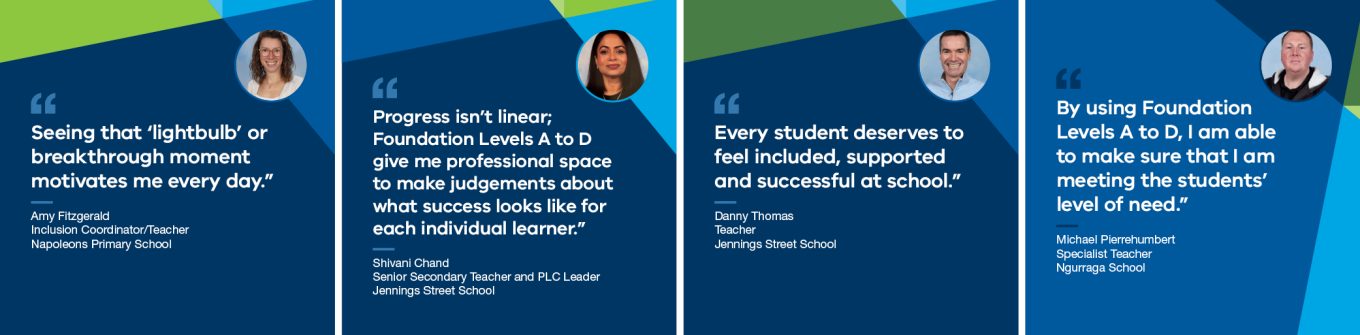
Image description:
"Seeing that 'lightbulb' or breakthrough moment motivates me every day" - Amy Fitzgerald, Inclusion Coordinator/Teacher, Napoleons Primary School
"Progress isn't linear; Foundation Levels A to D give me professional space to make judgements about what success looks like for each individual learner." - Shivani Chand, Senior Secondary Teach and PLC Leader, Jennings Street School
"Every student deserves to feel included, supported and successful at school." - Danny Thomas, Teacher, Jennings Street School
"By using Foundation Levels A to D, I am able to make sure that I am meeting the students' level of need.' - Michael Pierrehumbert, Specialist Teacher, Ngurraga School